
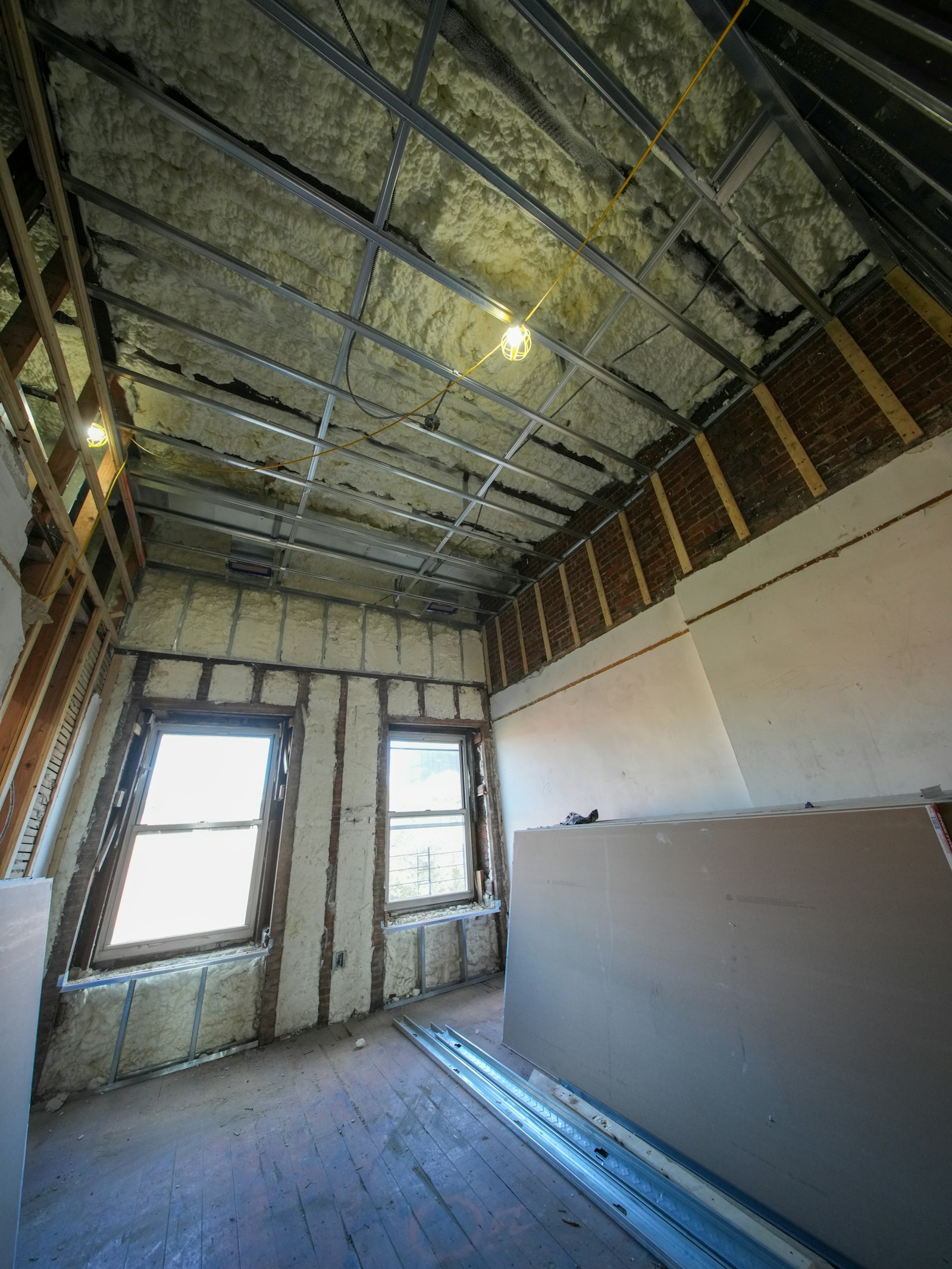
What is closed cell spray foam?
Closed cell spray polyurethane foam (SPF) is a rigid, high-density insulation applied as a two-part liquid that expands and hardens in seconds. Open cell foam is soft, spongy and breathable. Closed cell is the opposite: dense, water-resistant and it bonds hard to whatever it touches. In a UK loft that means the rafters, battens, sarking and felt.
Installers sold it as a two-for-one insulation and roof repair product between roughly 2015 and 2023, and millions of homeowners took it up under the Green Homes Grant and similar schemes. To be fair to it, the stuff does insulate well. The problem is that it also makes the roof structure almost impossible to inspect.
How to tell if you have closed cell (not open cell)
- Press it. Closed cell is hard, with no give at all. Open cell compresses like a sponge.
- Look at it. Closed cell is typically yellow, tan or cream and has a smooth, glossy skin. Open cell is white or off-white and looks rougher.
- Check the depth. Closed cell is usually 50–100mm thick. Open cell is often 150–200mm+ because it’s less dense.
- Ask us. Send photos through our free survey form and we’ll tell you which you have.
Why UK lenders refuse closed cell
Since 2023, following updated RICS guidance and pressure from insurers, the vast majority of mainstream lenders (Halifax, Nationwide, Santander, Barclays, NatWest, HSBC, Lloyds, Coventry, Yorkshire and nearly every building society) will either refuse a mortgage outright or down-value the property to zero when closed cell foam turns up in the roof. The reasons are technical but worth knowing:
- The roof timbers can’t be inspected. Once foam encases a rafter, a surveyor can’t assess its condition, so they have to assume the worst.
- Moisture gets trapped. Closed cell is vapour-impermeable. Water that does get in (and some always does, via missing slates or condensation) has nowhere to go.
- Removal is invasive. Lenders know that taking it off the wrong way damages the roof further.
- There’s no standardised warranty. Many installers are now out of business.
Our removal method
Every job uses the same process. We’ve refined it over 800-plus roofs, and the aim is always the same: every gram of foam off the timber, with the structure beneath left exactly as we found it.
Step 1 · Containment & protection
We sheet the loft hatch, seal service penetrations, and lay boards across joists. Dust-extraction HEPA units run throughout. Your living space stays clean.
Step 2 · Hand removal
We work along each rafter with scrapers and blades, lifting the foam off in controlled passes. It’s slower than machinery, but you can feel what the timber is doing under the blade, and nothing abrasive or mechanical ever touches the wood.
Step 3 · Detail work
We use smaller blades and wire combs on the tight corners where rafters meet battens, the edges of purlins and the awkward junctions around chimneys and valleys. This is where experience counts.
Step 4 · Waste removal
All foam waste is bagged, removed from site, and disposed of under our waste-carrier licence. Nothing gets left in your skip, your garden or your drive.
Step 5 · Timber inspection
Once exposed, the rafters are inspected, photographed and documented. If any remedial work is needed (rare, but it happens), we’ll show you on the spot and quote for it separately, with no pressure either way.
Timeline & what to expect
A typical 3-bed UK semi takes 2–3 working days. Larger properties, barns and commercial buildings can take longer, and we’ll give you a precise figure in the written quote.
- Day 0: Van arrives 8am, containment set up, first rafters being cleared by 10am.
- Day 1: Bulk of foam removed, waste bagged and loaded.
- Day 2: Hand finishing, timber inspection, photographs, final tidy.
- Day 3 (if needed): Certification pack compiled and emailed; hard copy posted.
Pricing guide
Every roof is different, so we don’t quote over the phone; it wouldn’t be fair on you. To set expectations, this is what most UK homeowners pay.
Small loft · under 60m²
2-day job
Cert included
3-bed semi or detached · 60–100m²
2–3 day job
Cert included
Large detached · 100–150m²
3–4 day job
Cert included
Prices include waste disposal, certification and timber inspection. No deposit is required and you pay on completion. Get your fixed price.
The certificate your lender gets
Every removal we complete includes a formal certification pack sent to you on completion. It’s built around what lenders ask to see, and it includes:
- Signed certificate of removal on Closed Cell Spray Foam Removal Ltd letterhead
- Before & after photographs of every rafter
- Timber condition report
- Waste transfer note
- Public liability insurance schedule
- Wording that follows current RICS guidance
You can forward this directly to your lender, solicitor or mortgage broker. Your buyer’s surveyor can use it to re-issue their valuation.
Questions homeowners ask
Will removing the foam damage my roof?
Not when it’s done properly. Because the work is done by hand, nothing abrasive or mechanical ever touches the wood; the foam is lifted off the timber rather than ground off it. Your rafters are left as they were before the foam was sprayed.
Do I need to move out while you work?
No. We work cleanly with full containment in the loft. You can carry on life as normal; apart from the van outside, you’ll barely know we’re there.
How soon can you come out?
Free surveys typically within 3–7 days of enquiry. Removals usually bookable 2–4 weeks out depending on your region. If you’re on a mortgage deadline, flag it in the enquiry form and we’ll prioritise you.
What if my timbers are damaged underneath?
We’ll show you photos and talk you through the options. In most cases the timbers are fine; they were just hidden. If repairs or a full re-roof is needed, our in-house roofing team can quote for it separately. No subcontractors.
Do I need to put insulation back after?
Yes, you’ll want to, both for warmth and to meet Building Regs if you’re selling. We offer traditional Rockwool or foil-backed insulation as a separate service, usually fitted the day after removal.